
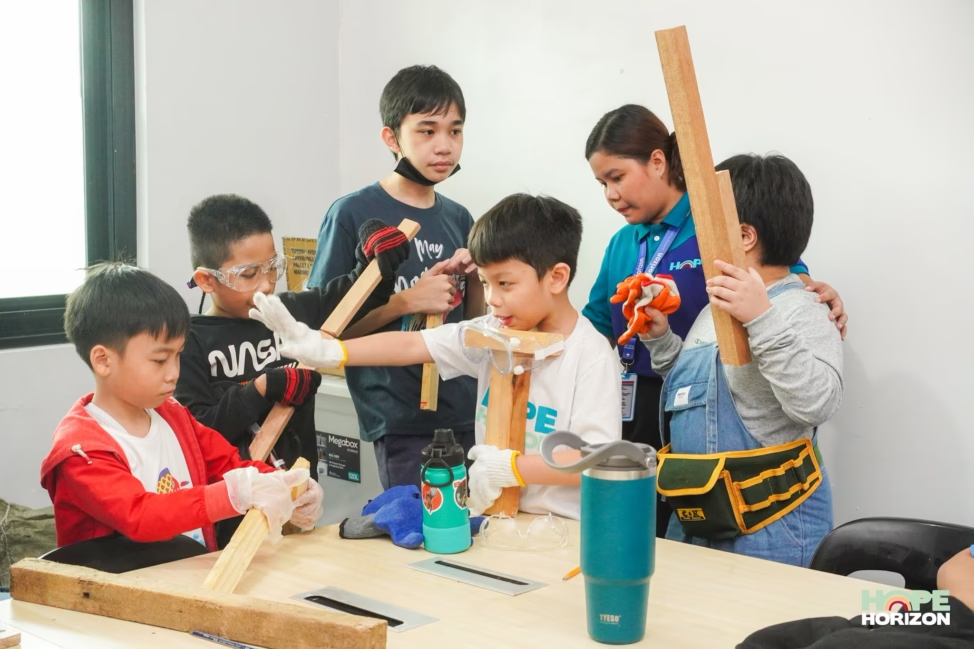
Discover research-backed evidence and practical strategies for parents and teachers on how hands-on progressive education transforms learning from passive lecture listening into active, long-term mastery.
Introduction: Beyond the “Empty Vessel” Classroom
For generations, conventional schooling operated on a simple assumption: the teacher holds knowledge, and students passively sit, listen, and receive it. However, cognitive science and educational research demonstrate that human brains do not learn effectively through passive absorption. Learners are not blank slates or empty vessels waiting to be filled with isolated facts.
At its core, progressive education replaces passive lecture delivery with active, hands-on, experiential learning. Rather than asking, “Did students memorize the lesson?”, a progressive, research-grounded approach asks, “Do students understand the concept, and can they actively apply it to real-world situations?”.
The Science of Learning: Why Passive Lectures Fall Short
Cognitive learning theory explains that meaningful learning occurs when the brain actively processes information, connects it to prior knowledge, and constructs internal schemas. Passive lectures often rely on surface-level exposure and short-term rote memorization, which crumble when students are asked to solve unfamiliar or complex problems.
- Active Processing over Passive Reception: Students learn best when they are active participants directing their own cognitive processes through problem-solving, discussion, and practical execution.
- The Role of Prior Knowledge: Deep comprehension requires bridging new concepts with existing personal experiences and mental frameworks.
- Cognitive Activation: International benchmarks, including PISA research, show that teaching strategies featuring cognitive activation—where students explain principles, test hypotheses, and analyze data—lead to significantly higher student engagement, curiosity, perseverance, and enjoyment of learning compared to passive fact memorization.
What Real Hands-On Learning Looks Like (And What It Isn’t)
Coined by progressive philosopher John Dewey in the early 20th century, experiential learning is often summarized as “learning by doing”. However, true progressive education is not merely unguided activity or busywork; it is learning while doing combined with conscious reflection.
- Learning While Doing: Instead of requiring students to listen to lectures for weeks before touching a real-world task, learning and application happen simultaneously.
- The Crucial Step of Reflection: Without structured reflection, students may participate in an activity without articulating or understanding the underlying scientific, mathematical, or historical principles. Reflection transforms raw experience into transferable knowledge.
- Student Agency and Voice: Authentic project work gives learners voice and choice over their inquiries, fostering intrinsic motivation rather than relying on extrinsic rewards or competitive rankings.
The Research Evidence: What the Data Tells Us
The push for hands-on, progressive education is grounded in over a century of empirical research:
- The Eight-Year Study: One of the most comprehensive educational studies in history tracked over 1,500 students from progressive, hands-on high schools through college. Compared to matched peers from traditional lecture-based schools, progressive graduates equaled or surpassed their peers on all academic outcomes, demonstrating higher grades, greater intellectual curiosity, and superior problem-solving resourcefulness.
- Workplace and Lifelong Skill Formation: OECD reports on 21st-century skills emphasize that information-processing abilities and adaptive problem-solving rarely develop through passive listening. They require continuous cognitive effort, collaborative teamwork, and hands-on trial and error.
- Intrinsic Motivation: Research confirms that drill-and-practice worksheets and high-stakes test prep yield diminishing returns in long-term growth, whereas project-based inquiry drives sustained intrinsic interest and self-efficacy.
Practical Strategies for Teachers
Transforming a classroom from a passive lecture hall into an active progressive environment does not require discarding structure; it requires shifting the direction of classroom activity:
- Implement Kilpatrick’s Project Method: Structure learning around multidisciplinary thematic units where students solve real community problems or create tangible artifacts (e.g., building a model ecosystem, designing a class budget, or writing a community history guide).
- Integrate Cognitive Learning Activities: Use strategies like Think-Pair-Share, concept mapping, problem-based learning scenarios, and self-explanation tasks to make student thinking visible.
- Build In Daily Reflection: Require short reflection journals or exit cards asking: “What strategy helped you solve this?”, “What challenged you?”, and “How does this connect to what you already knew?”.
- Shift Assessment to Portfolios: Evaluate growth through student productions, project demonstrations, and narrative self-assessments rather than relying exclusively on traditional multiple-choice exams.
Practical Strategies for Parents
Parents play a vital role in reinforcing progressive, active learning principles at home:
- Encourage Inquiry over Quick Answers: When your child asks how something works, resist the urge to deliver a mini-lecture. Ask: “What do you think is happening?” or “How could we test that out together?”
- Embrace Learning Through Trial and Error: Normalize mistakes as essential feedback loops during hands-on projects, gardening, cooking, or building.
- Prioritize Real-World Application: Connect household activities—like managing a shopping list, measuring ingredients, or exploring local nature—to mathematical, economic, and scientific concepts.
- Focus on Intrinsic Curiosity: Praise effort, strategy, and perseverance rather than focusing solely on letter grades or extrinsic prizes.
When classrooms move away from passive lectures and toward hands-on progressive education, learning ceases to be a burden of memorization and becomes a lifelong process of discovery. By fostering student agency, collaborative problem-solving, and reflective thinking, both teachers and parents can equip young people with the deep comprehension and adaptability required for a complex world.