
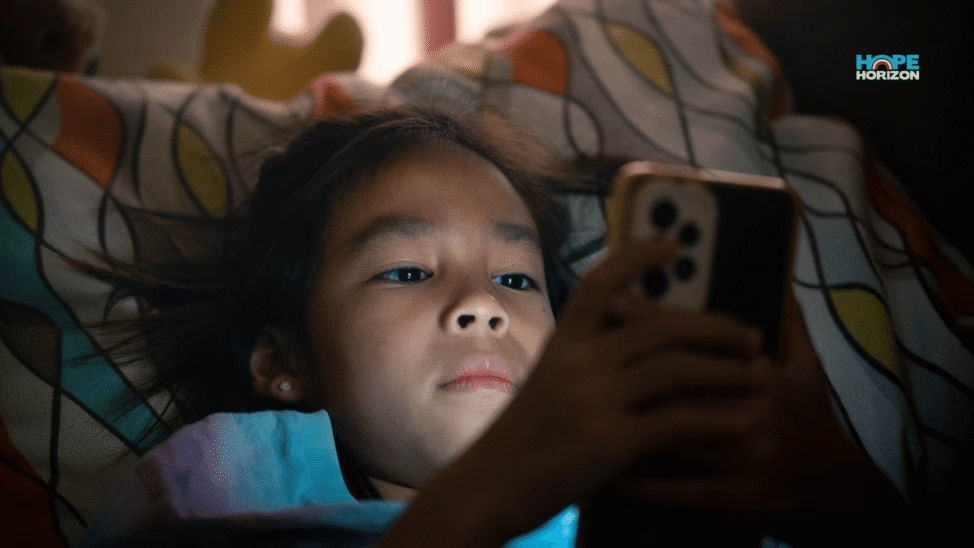
A major international research review has linked greater screen exposure with lower overall academic achievement, weaker language skills, and more emotional and behavioral difficulties among children and teenagers.
Published in JAMA Pediatrics on September 28, 2026, the review combined findings from 23 meta-analyses representing approximately 2.8 million children across 64 countries. It examined research involving children aged 18 and younger.
For parents, the findings raise a familiar concern: how can families make technology useful while protecting the experiences children need to grow?
The evidence requires careful interpretation. The review identified associations; it does not establish that screen exposure caused these difficulties. It also did not find statistically significant associations with every outcome examined, including individual mathematics, science, and reading scores. These results should not be interpreted as proof that those areas are unaffected.
In CNN’s September 30 report, senior author Sheri Madigan, a psychology professor at the University of Calgary, emphasized that many associations were relatively small. She also cautioned against treating all screens as inherently harmful. Digital tools can support learning, creativity, and connection, but their use can compete with time for sleep, physical activity, relationships, and play.
For Filipino families juggling work, school requirements, and household responsibilities, this offers a starting point for reviewing everyday routines.
A useful question is: What is this screen activity helping my child do—and what is it replacing?
Parents might look at whether a child is discussing ideas, creating something, or connecting with others during a digital activity. They can also check whether the day still leaves enough room for movement, shared meals, conversations, and activities away from devices.
Hope Horizon School for Giftedness connects this conversation to its progressive education approach. The school emphasizes student-centered teaching, critical thinking, creative freedom, and hands-on activities that allow children to explore concepts through experience.
At home, parents can put that approach into practice through simple activities:
- Bring a lesson into everyday life. Explore fractions while preparing food, measure objects around the house, or compare prices during grocery shopping.
- Turn viewing into conversation. After an educational video, ask your child to explain the idea, draw it, or demonstrate it using available materials.
- Offer opportunities to create. Make space for drawing, building, storytelling, gardening, and imaginative play.
- Plan shared activities away from devices. Choose routines the family can sustain, such as reading together or taking a walk.
These are suggested learning activities, not interventions tested by the new review.
The same principle can guide homeschooling. Hope Horizon’s supplied homeschool brochure describes parent coaching, learning materials, online classes, and opportunities to participate in school events. Families can use that support to plan lessons that continue through practical activities beyond the online session.
For example, an online discussion about plants could lead to growing seeds and recording observations. A lesson about money could become a budgeting activity. A story could inspire a drawing, a conversation, or a short performance.
The research gives parents and educators a reason to examine children’s digital routines thoughtfully. Hope Horizon’s practical contribution is to help families build days with opportunities to ask questions, experiment, create, and connect.
To learn more about Hope Horizon’s progressive education and homeschool programs, contact inquire@hopehorizonedu.org or 0935 193 7934.